
Rapture is the only word to describe it.
Her shoes were long gone, her bare feet floating as she danced on her toes, her body moving like the determined needle of a compass pulled by an electromagnetism imperceptible to the palm that held it.
Her dark hair had been loosed from the brown twine tied at the base of her long braid and was beginning to unravel itself.
Her head swung back in long, slow circles. If her eyes weren’t closed, they were rolled back in her head. She needed no vision to walk her backwards, sweeping, spiraling loops without ever grazing a wall or stubbing a toe or backing into one of the many people jumping, running, and swinging their arms frenetically.
Now fully free, waves of cascading hair swung in slow motion murmurations. Her lips whispered some arcane language not English. The music kicked up, the harmonies thicker than molasses in a disorienting, intoxicating vibration.
Whatever drums are missing from the stage are still beating for some people… those “slain in the spirit.”
This was what was referenced as “twirling in the spirit,” which might be an Appalachian phenomenon.
A man trots in place like a show pony metronome, his arms swinging double time, back and forth, his feet beating the floor in a perfect rhythm and a cadence dislodged from spacetime.
The traveling revival singer— a behemoth of a man with a wire-thin mustache and a red tie that only reaches to his sternum— sings, “Moses, take your shoes off, you’re on hallowed ground.”
The preacher grabs his embattled Bible and takes off, running behind the piano and across the bench, off the stage and across the floor. He’s a large man in his late 40s, easily over six feet tall and 250 pounds.
He jumps up onto that first pew and climbs up to the backrest, then runs across the curved tops of the lacquered pine pews like a seasoned stuntman without missing a step.
Old ladies lean sideways to give him free passage.
Occasionally, he lets out a war cry like an internal pressure valve had been tripped.
It’s day one of a revival that will stretch into a second unplanned week, the energy intensifying every service. Satanic panic, rock ‘n roll, alcohol, drugs, temptation, and the rapture were the common refrains.
Watching the Sky
Every time the coal train sounded before laboring across that Chauncey bridge, I looked to the East, to the sky, expecting to see the angels sounding their trumpets.
The rapture consumed my childhood thoughts. I monitored my own mind, obsessing over every fleeting word in my internal dialogue lest I had a sinful intrusive thought. I’d need to repent in case of rapture.
Eternity was a long time to spend in a lake of fire.
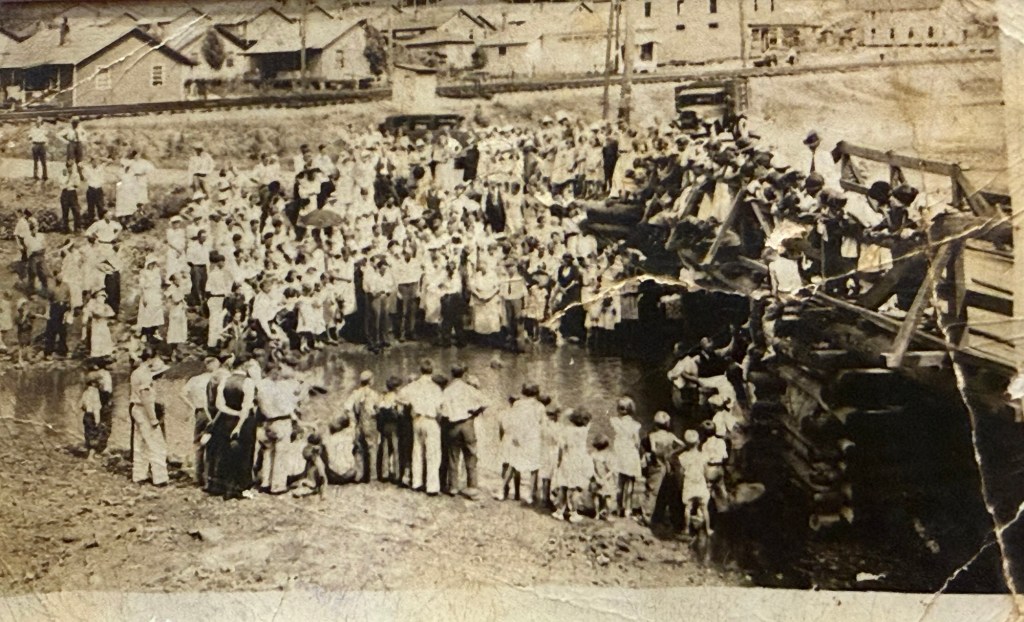
In adulthood, it took more than a decade to unpack the trauma and debilitating OCD caused by Freewill Baptist fundamentalism— and to give myself permission to not take every word literally, even though the cognitive dissonance of contradictions had caused me problems since my earliest memories.
I went through extreme versions of the stages of grief that I almost didn’t survive. In parallel, old friends and family stayed with it, found joy in it, and raised their own children the way they were raised.
For a long time, I was angry at them. I kept a distance from all things West Virginia and was utterly alone for years.
I’ve never been alone in any literal way. I’ve never been single for more than a few months. I’ve always had many friends— but that wasn’t really me. It was the dissociated, artificial self I authored out of shame and some misguided drive to pass as “normal.” Worldly.
That person didn’t look like me, didn’t talk like me, didn’t ignite, study, eat, destroy, walk, sing, breathe, or think like me.
Only after connecting with my ancestors did I come to a place of acceptance— not only with who I was, but also with the circumstances of my life and the people from the coal camps.
I had to bear witness to what got me and the people in my community to the place from my youth I watched disappear over the last four decades.
You can’t just let go and walk away from a closed culture. Letting go is an ungluing. There’s no ground beneath your feet.
I believe the Christians of Appalachia are so connected to the idea of the rapture because they’re holding on to the ancestral cultures they lost. Maybe it’s a jarring of ancestral memory for them— a conduit to stay plugged into something resembling their roots.
Old Ways Under a New Name
There were three snake-handling churches within a two-mile radius of my home growing up. In kindergarten show-and-tell, a girl brought a photo album of her church. It had a lot of snakebite pictures— of adults and kids. Rattlesnakes and copperheads.
Coal camp church culture didn’t look like anything American.
The mysticism and ambiguity of Revelation and other “end times” prophecy in the Bible offered permission to get deep into blood moons, solstices, meteorites, equinoxes, astronomy, numerology, and eclipses. They can “look to the skies” in that context for “signs and wonders.” They can have dreams and visions.
Melungeons had a deep relationship with the moon and an intentional disregard for the status quo. There are centuries of ancestral traditions tied into spiritualism that are now strongly rejected as “soothsaying,” evil, and even sacrilegious— despite these same traditions being embraced elsewhere.
Many of those traditions just got renamed:
- The trance-like, rhapsodic “slain in the spirit”
- The anointing with oil
- The snake handling
- The chanting, now called “speaking in tongues”
- The twirling and dancing
- Casting with the repetition of specific Bible verses
- Prayer cloths
- The grounding and bare feet
- The long braid
- Washing the feet of another
Isaiah heals King Hezekiah’s boil with a poultice of figs. Jesus himself spits on mud and rubs it in a man’s eyes to heal him of blindness. But if you try something like that in a small town, you’re likely to end up in a witch trial.
The mine operators— with the help of the Klan and their payrolled, propaganda-propagating preachers— cultivated a culture of white supremacy, and the church was the engine of assimilation.
The prize of whiteness, of respectability, against the backdrop of Jim Crow, held coal miners stuck in a place of contextualizing everything within the duty-bound loyalty of their ancestral cultures against the dogma of the Baptist and Pentecostal branches— branches that primed them to believe betraying their ancestral traditions was a demonstration of righteous martyrdom.
Ethnic cleansing was painted as a path to salvation, respectability, and civilization.
The Sequestering
Everything I read about residential schools sounds like the deculturizing culture I witnessed grow its teeth and claws as it sequestered everything I loved under a veil of whiteness.
Between 1980 and 2000, the church fought a Quixotic war with the devil— and with heavy metal, promiscuity, and secularism.
Around 2000, when the Y2K rapture didn’t happen, Fox News and the Trinity Broadcasting Network became the new driving agents as the waning congregations of the old holler churches could no longer tread water with the younger generations anxious to prove their modernity.
The rising availability of the internet, more than 10 channels on the television, and the hard Left proletariat classes of southern WV clashed with the liberal Democrats who embodied everything West Virginians hated: academia, political correctness, an anti-coal approach to sustainable energy that ignored the contributions of miners or villainized them, gun control, populist messaging, and the culture of the “elite.”
The pursuit of wealth was not a value of the Old Ways.
My grandparents were all staunch Left. My Papaw Herndon was a sweary man, but there was nothing he could call anyone that was worse than Republican. I thought that was the worst swear word.
There was a gas station we passed any time we headed towards town, and he’d never stop there. The owner was a Republican.
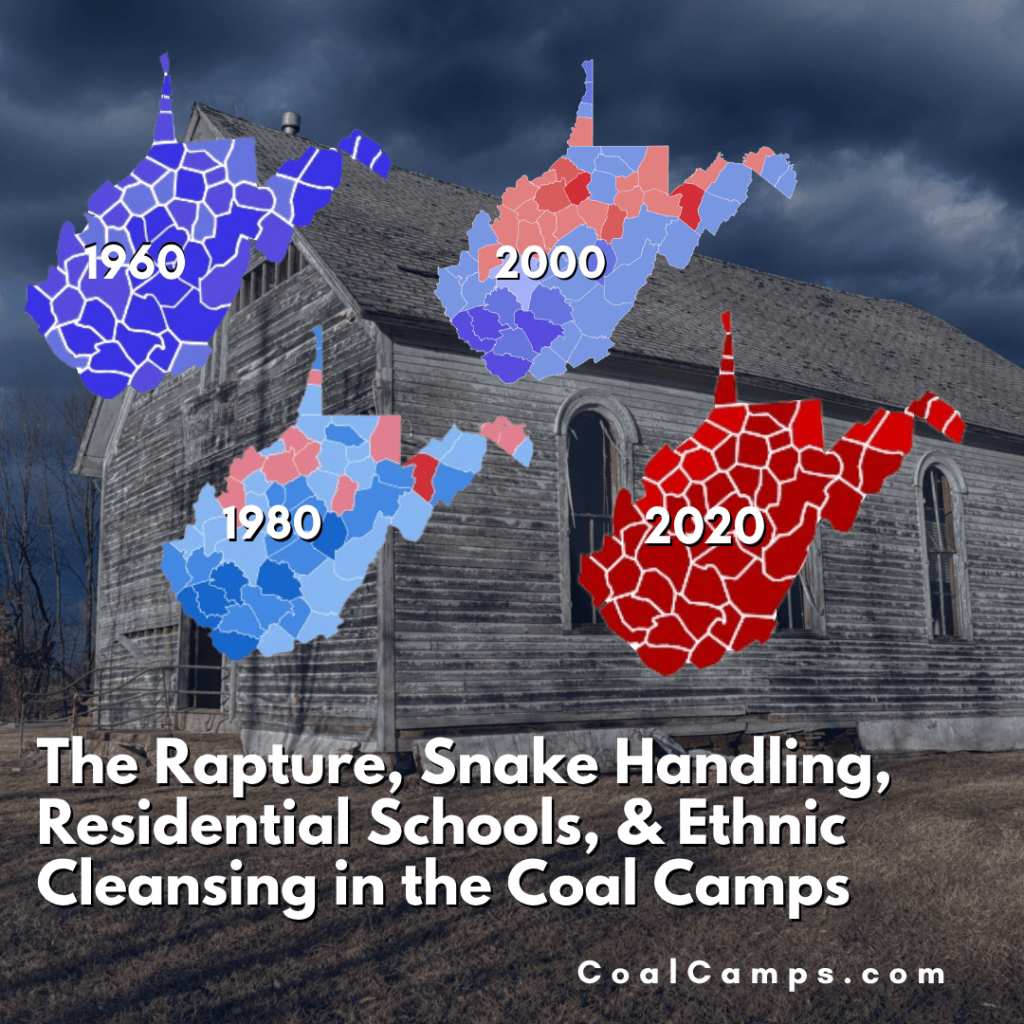
See that enduring dark blue area in the southernmost part of the state in the 2000 map? That’s where I’m from. Melungeon coal country.
As my grandfather’s generation joined the ancestors, many Gen X-ers left the state, and the Boomers became the chief voting bloc.
Prior to the Boomer generation, the Melungeons of WV— especially in coal country— had been through the Mine Wars, two World Wars, the split of the Civil War that made WV part of the Union and separate from Confederate Virginia, Jim Crow, chattel slavery, Indian Removal, countless battles, and the Trail of Tears.
There was a period of time during the Boomer generation’s early entrance into the mine industry where it seemed like people had finally made it. I can imagine there was probably a brief span of time when my grandfather’s generation might have felt like Moses watching their people enter the Promised Land.
The Boomer generation had access to pop culture. Television. Jobs were briefly safer and paying a decent wage— thanks to unions. They had exposure to the rest of the world, and they lost touch with the Old Ways.
None of that is wrong. It’s expected. It’s just what is.
But to me, it’s devastating.
The Left looked a lot less like the proletariat and a lot more like academia— smug, pretentious, and condescending. Ungrateful. Morally superior.
The Right Trojan-horsed into the coal camp communities through the church, exacerbated exponentially by Jerry Falwell’s white supremacist “Moral Majority.”
You make fun of everything “hick” and “Poor” and “backwards” and uneducated. You imitate the accent. You mock. You associate bigotry with stereotypes of poverty. You throw out “inbred” as an insult.
They think of you as self-absorbed, uncaring, fake, performative, privileged, pretentious outsiders who have the luxury of arguing over trivialities and offering unsolicited advice that would never work for them.
I hated what West Virginia became. I hated the people. I hated myself. I hated you. I was perpetually angry.
When you make someone believe they are supposed to be ashamed of their core identity, you put them in a cycle they’ll contend with for years— if not their whole lives.
The only way to stop being the policed is to become the police. I didn’t want to be either.
There’s something in that vigilant rapture-watching for West Virginians that I believe is both a product of generations of manipulation and exploitation, and an attempt to make contact with the past. I could be wrong.
It is hope that all that suffering will be rewarded. The evidence of things not seen.
People without hope don’t survive. They don’t want to survive.
No one else is coming to deliver them, and no one ever has.
And you mock them.
They are tired. They are born tired. They can’t breathe. Their bones hurt. They don’t have access to anything that connects them to what they used to have except in the mysticism of Revelation.
End times prophecy is where they can find significance in blood moons again.
Truth and Reconciliation
Following the Civil War and the emancipation of enslaved people, the Jim Crow era saw new pressures for mixed-race Melungeons.
The Conference of Charities and Corrections was an annual meeting established in the 1870s in the United States— the “white savior industrial complex” assembled to deal with the Poor and the displaced following the Civil War. It eventually rebranded to become the National Conference of Social Work.
“Charity and Corrections” is a peak colonizer pairing that would be laughable, like a parody of itself, if it weren’t real. It sounds straight from a Mark Twain or Ralph Ellison satire.
In 1892, Colonel Richard Henry Pratt — the founder of the Carlisle Indian Industrial School, the first federally funded off-reservation boarding school — delivered a speech to the 19th Annual Conference of Charities and Corrections. In it, he laid out his vision for “civilizing” Native peoples through forced assimilation. This is the blueprint.
“Of course, the more advanced [Indians], those who have a desire to become civilized, and to live like white men, who would with little encouragement go out into our communities, are the first to join the missionary’s forces. They become his lieutenants to gather in others.”
If you make someone’s entire culture into a “savage” joke and a problem, then they hate you. But a few generations pass, and the origin of the joke is lost to history. The propaganda becomes the status quo, no one knows where to place their anger, and many eventually come to hate themselves.
Everyone who’s carrying many generations of being on the “them” side is vulnerable to jumping at any opportunity to be an “us.” You can’t know what that’s like — that pressure to destroy anything left of you to become something else — unless you’ve lived under mountains of imposed shame.
When a manufactured, strategic new wave of “missionaries” of the white savior complex arrives to groom the disenfranchised to be “valuable,” they sometimes go harder than anyone to get away from the shame and stigma. Suddenly, they’re being praised. Suddenly, they’re experiencing gains. So they keep sprinting until they have outrun everything they used to be — or until they run out of steam.
They work themselves straight to the grave and the preacher praises their work ethic at their funerals.
Pratt said in the same speech:
“Scattered here and there, under the care and authority of individuals of the higher race, [Black formerly enslaved people] learned self-support and something of citizenship, and so reached their present place. No other influence or force would have so speedily accomplished such a result.”
He is claiming that Black people succeeded only because they were forced into proximity with white people.
“Left in Africa, surrounded by their fellow-savages, our seven millions of industrious black fellow-citizens would still be savages. Transferred into these new surroundings and experiences, behold the result.”
He erases entire nations, boils down whole societies to “cannibals,” and attributes the accomplishments of Black people to proximity to white Protestant capitalism.
“They became English-speaking and civilized, because forced into association with English-speaking and civilized people; became healthy and multiplied, because they were property; and industrious, because industry, which brings contentment and health, was a necessary quality to increase their value.”
He is suggesting that slavery and forced assimilation was good for Black people — and implies Natives also need to be forced to be industrious under capitalism so they will be more valuable to the economy.
This is the same supremacist argument we see politicians making today against teaching honest history — the suggestion that slavery benefited Black people because of proximity to the “higher race.”
And this is the pitch Pratt used to sell Carlisle Indian Residential School:
“A great general has said that the only good Indian is a dead one, and that high sanction of his destruction has been an enormous factor in promoting Indian massacres. In a sense, I agree with the sentiment, but only in this: that all the Indian there is in the race should be dead. Kill the Indian in him, and save the man.
“Carlisle has always planted treason to the tribe and loyalty to the nation at large. Carlisle fills young Indians with the spirit of loyalty to the stars and stripes, and then moves them out into our communities to show by their conduct and ability that the Indian is no different from the white or the colored.”
If you erase a people’s culture and villainize them, you can make them engage in the same brutality against themselves that you imposed on them. Carlisle acted as agent provocateur, conditioning Natives to become nationalists who were grateful for the ethnic cleansing and cultural genocide to which they were subjected.
“It says to him that, if he gets his living by the sweat of his brow, and demonstrates to the nation that he is a man, he does more good for his race than hundreds of his fellows who cling to their tribal communistic surroundings.”
The “missionaries” of whiteness got a hold of West Virginians slower than the rest of the country. The people here fought it off for a long time— and the federal government dropped literal bombs on them for resisting.
When the mines owned the schools, the land, the houses, the stores, the churches, the police, the teachers, the preachers, and the currency — there is no escape. There is no avoiding it.
Tabula Rasa and the Blank Slate as a Weapon
Pratt said of the recently-freed enslaved people:
“Horrible as were the experiences of its introduction, and of slavery itself, there was concealed in them the greatest blessing that ever came to the [Black] race — seven million of blacks from cannibalism in darkest Africa to citizenship in free and enlightened America; not full, not complete citizenship, but possible — probable — citizenship, and on the highway and near to it.”
Pratt also said: “It is a great mistake to think that the Indian is born an inevitable savage. He is born a blank, like all the rest of us.”
What Pratt means here is that he personally has no connection to an identity — because that was erased — so he believes identity is something earned through willing conformity and “the sweat of his brow.”
The concept of tabula rasa — Latin for “blank slate” — is pseudoscience that has been used, and continues to be used, to justify all manner of evils committed against people who aren’t assimilated to the status quo. It is the idea that people are born without any genetic predispositions, instincts, or memory, and become entirely a product of their external environment.
Tabula rasa has been invoked to justify:
- Ethnic cleansing and forced assimilation
- Conversion therapy for queer people
- Behavior therapy for autistic people
- “Civilizing missions” imposed on native populations globally
Ivar Lovaas, the pioneer of autistic conversion therapy — who adapted queer conversion therapy and applied it to autistic children — said:
“You see, you start pretty much from scratch when you work with an autistic child. You have a person in the physical sense — they have hair, a nose and a mouth — but they are not people in the psychological sense. One way to look at the job of helping autistic kids is to see it as a matter of constructing a person. You have the raw materials, but you have to build the person.”
To break the will and spirit of autistic children, Lovaas created a therapy that looked very much like the approach of Indian residential schools and coal camp propagandists— dehumanizing them, torturing them for noncompliance, and rewarding them for compliance.
That “therapy” caused irreparable harm. And even today, painful electric shocks stronger than a cattle prod are used at a Massachusetts residential school for disabled people— a school that has killed multiple autistic children and adults. That school sits only minutes from Plymouth Rock, where the Pilgrims are still portrayed as friendly saviors instead of being recognized as the people who slaughtered and enslaved the Wampanoag people.
Autistic people are not less than full people.
Africans were not cannibals.
Natives were not savages.
The Question Is Not Rhetorical
Do you dehumanize West Virginians and other impoverished, disabled, and exploited people the way Pratt and Lovaas did— rendering it acceptable in the mainstream to benefit from their oppression while simultaneously treating them as inferior for not being “civilized” like you?
That’s not rhetorical.
Do you do that?
Do you make fun of people and dehumanize them for not being as pure and upright as you? For being uneducated? For being fat? For being “hicks”? Low class? Inbred?
Pratt inadvertently admits that what he really means by whiteness is blankness— an empty slate to be molded to the dominant narrative. Because Pratt himself was born into generations of erased identity. His identity was the police, not the policed. Charities and Corrections.
White doesn’t exist. But as a social construct, whiteness is an election to become the police. That’s the Left and the Right both. Exclusive clubs. The center mass. They shape you, too.
What else does the permanent underclass have in the vein of hope but to look for a cosmic retirement plan in the form of rapture?
According to Pratt— the harbinger of individualism— we’re not supposed to be in community. We’re supposed to be an island, so blank that we can only earn our worth through competition and self-erasure under capitalism.
How many people are still blaming all ills on “communism” with no idea what they’re actually against? That sentiment didn’t start with the Cold War. It came here with Columbus. It decimated indigenous and nomadic populations all over Europe and West Asia before it came here.
Collectivism as practiced by indigenous society: helping each other, being in community, thinking of our impacts on others and the planet, and preventing such extreme inequity that people can’t afford to survive.
Whiteness is a teeming emptiness. A blankness. An identity to earn through compliance with the mass delusion that you are exceptional.
It’s not your heritage, either, no matter how light your skin is. You came from a place, and from indigenous cultures that existed before colonialism.
Democrats and Republicans are Catholics and Protestants— two sides of one machine that have been the “us” in the us versus them equation since before Columbus, adjusting their behaviors to remain the majority on top and ignoring the consequences for all the “thems” out there.
We have a lot of work to do to undo the damage done to all of us.
The first step is realizing that if you aren’t on the bottom rung of society, that doesn’t mean you’re valuable for any reason other than what you contribute to the people at the top in the pyramid scheme that is America.



Leave a Reply